Nuclear at Port Augusta? No Way!

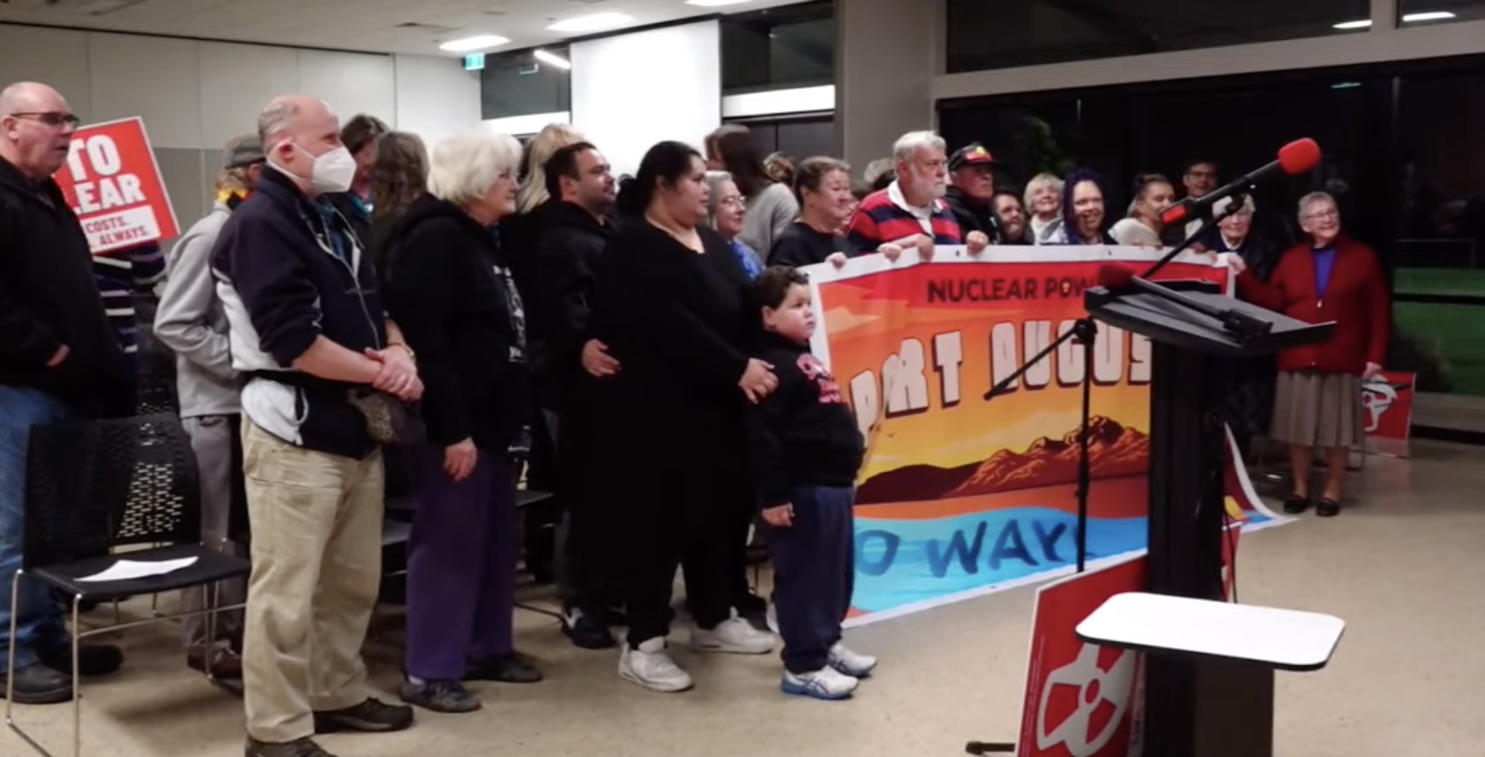
A large crowd at the Port Augusta anti-nuke meeting on Wednesday, 30th April agreed that nuclear power made no economic or ecological sense, and that renewables were the preferred option.

I’ve just returned from a powerful community meeting where a group of Aboriginal people came down from Port Augusta to tell people in the marginal SA electorate of Sturt about their opposition to the Coalition’s plans to build a nuclear reactor in their town.
Clinton (Stano) Dadleh, Aunty June Lennon, Aunty Vivienne McKenzie, Uncle Lindsay Thomas, Glen Wingfield (via Zoom) and Rhenee Lester gave moving accounts of their lived experience of Port Augusta and the impact of the nuclear industry on their families, while Dr Kate Wylie (Doctors for the Environment) and Dr Jim Green (Friends of the Earth) critiqued the Coalition’s nuclear plan in detail.
For those who couldn’t make it, the meeting was live streamed and can now be viewed on the following link:
Philip White
(Friends of the Earth Adelaide)
Election related material authorised by Cam Walker, Friends of the Earth, 312 Smith St, Collingwood, VIC, 3066
Nuclear Power Community Meeting in Sturt

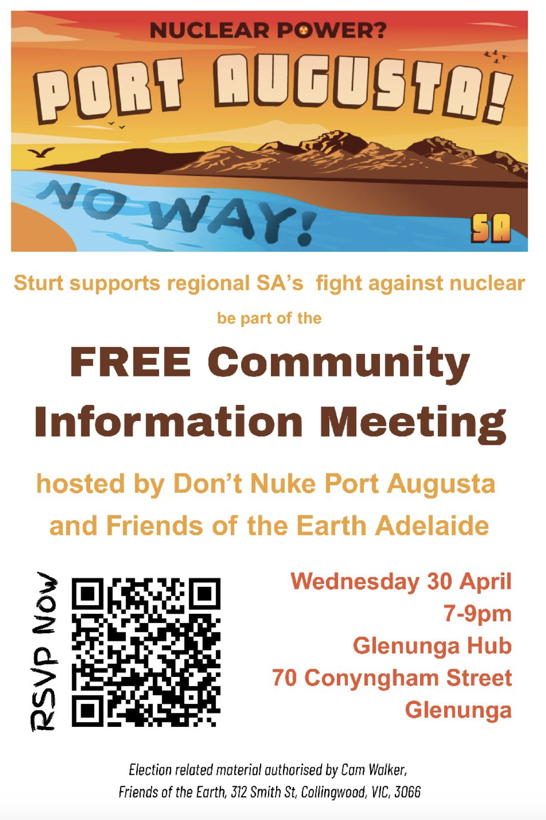
There will be a public meeting in the marginal SA electorate of Sturt to support people from Port Augusta opposing the proposal to build a nuclear reactor in their city. Everyone is welcome to come.

Hear speakers from Port Augusta (including Aboriginal people) who oppose a Nuclear Power Plant in their city and our state.

The meeting will be on Wednesday 30 April from 7pm at the Glenunga Hub,
70 Conyngham Street Glenunga

(Directly off Greenhill Road or Glen Osmond Road)

Speakers include:
Clinton (Stano) Dadleh from Don’t Nuke Port Augusta
Dr Jim Green, Friends of the Earth Australia
Dr Kate Wylie, Doctors for the Environment

The event is hosted by Friends of the Earth Adelaide and Don’t Nuke Port Augusta.

Please book your free ticket at the Humanitix link below to help us organise.

https://events.humanitix.com/nuclear-power-community-meeting/tickets

Election related material authorised by Cam Walker, Friends of the Earth, 312 Smith St, Collingwood, VIC, 3066

Response to Osborne Submarine Construction Yard Strategic Assessment

Our recommendations:

1. Correct the factual errors regarding the effects of radiation.

2. Include active commissioning in the assessment.

3. Include the disposal of radioactive waste in the assessment and publish plans for management, storage and disposal of all streams of radioactive waste, including intermediate and high-level waste and spent nuclear fuel.

4. Include a proper analysis of the risks and consequences of incidents and accidents that could lead to a release of radioactive material into the environment.

5. Inform the public about the potential for exposure to radiation and the levels of radiation they could be exposed to.

6. The Commonwealth Government should consult with other levels of government, the Australian Radiation Protection and Nuclear Safety Agency, emergency services and with the general public to develop a response plan for radiological emergencies.

7. Publish the Strategic Assessment Plan before finalizing the Strategic Impact Assessment Report.

Read our full submission:

250314AUKUS SIA – FoEAdelaide

Response to Submarine Construction Yard Environmental Impact Statement

Our submission raised questions about assumptions made about the nuclear submarine agreements:

“The Environmental Impact Statement (EIS) is premised on the assumption that the proposed AUKUS nuclear submarines are in Australia’s strategic interest (pp. 9-10) and South Australia’s economic interests (pp. 12-13). Both these premises are false.

Many highly qualified defence experts argue that nuclear submarines are not in Australia’s strategic interest. [1]
Along with these experts, and retired senior politicians like Paul Keating, Gareth Evans and Malcolm Turnbull, we believe that Australia will be less safe if it acquires nuclear powered submarines. Although it is the federal government that has made this strategic blunder, the EIS should not lend it any credence (as in section 1.5.4).

AUKUS submarines will also be prejudicial to our economic interest. Some of the abovementioned analysts don’t think Australia will actually ever get the promised nuclear submarines, certainly not in a reasonable time frame. This is a view not restricted to left-leaning people. Conservative commentator Greg Sheridan has criticised AUKUS for this reason.[2]”


[1] Hugh White, “From the submarine to the ridiculous”, The Saturday Paper, 18 September 2021 https://www.thesaturdaypaper.com.au/2021/09/18/the-submarine-the-ridiculous/163188720012499#mtr
Major General Michael G Smith AO (Ret’d), ‘How should Australia defend itself in the 21st century? Silencing the drums and dogs of war’, The New Daily, May 26, 2023 https://thenewdaily.com.au/news/world/2023/05/26/how-should-australia-defend-itself-in-the-21st-century-silencingthe-drums-and-dogs-of-war/
Sam Roggeveen, ‘Spiky questions remain for AUKUS proponents’, Inside Story, 19 March 2024 https://insidestory.org.au/spiky-questions-remain-for-aukus-proponents/

[2] Greg Sheridan, ‘Our nuclear subs fantasy adds up to military net zero’, The Australian, 6 October 2021. https://www.theaustralian.com.au/commentary/our-nuclear-subs-fantasy-adds-up-to-military-net-zero/newsstory/cec3b5e94c5bacac405a5eb535b3a628

Read our full submission:

250314AUKUS EIS – FoEAdelaide


Submission to the Joint Standing Committee on Treaties re “Agreement … for Cooperation related to Naval Nuclear Propulsion”

Philip White wrote a detailed submission, which he summarises:

We strongly believe that the Agreement should not be entered into in the first place. The proposal for Australia to acquire nuclear powered submarines should be rejected on security, safety, nuclear non-proliferation, environmental and economic grounds. Given that both sides of politics have committed themselves to these submarines, it would take some political courage to reverse course. If the government does not have enough political courage to make the right decision now, then it should encourage the US and UK governments to do the arithmetic and quickly come to the conclusion that they can’t build submarines fast enough to supply Australia without degrading their own nuclear propulsion programs. The quicker everyone acknowledges this and exercises their right to terminate the Agreement, the less money will be wasted.”

The full submission can be downloaded:

240826JSCOTSubmission – FoEAdelaide